
Button Tab RFQs: Declare Fabric and Hardware
What material information should an adjustable button-tab RFQ request? Ask the supplier to identify the materials of the textile tab, attached button, stitching and any relevant finish separately, then link that declaration to the offered sample and variants. Keep unsupported fields open. A black appearance, a shiny button or a product colour name does not establish fibre composition, an alloy, a coating or a finished-item property.
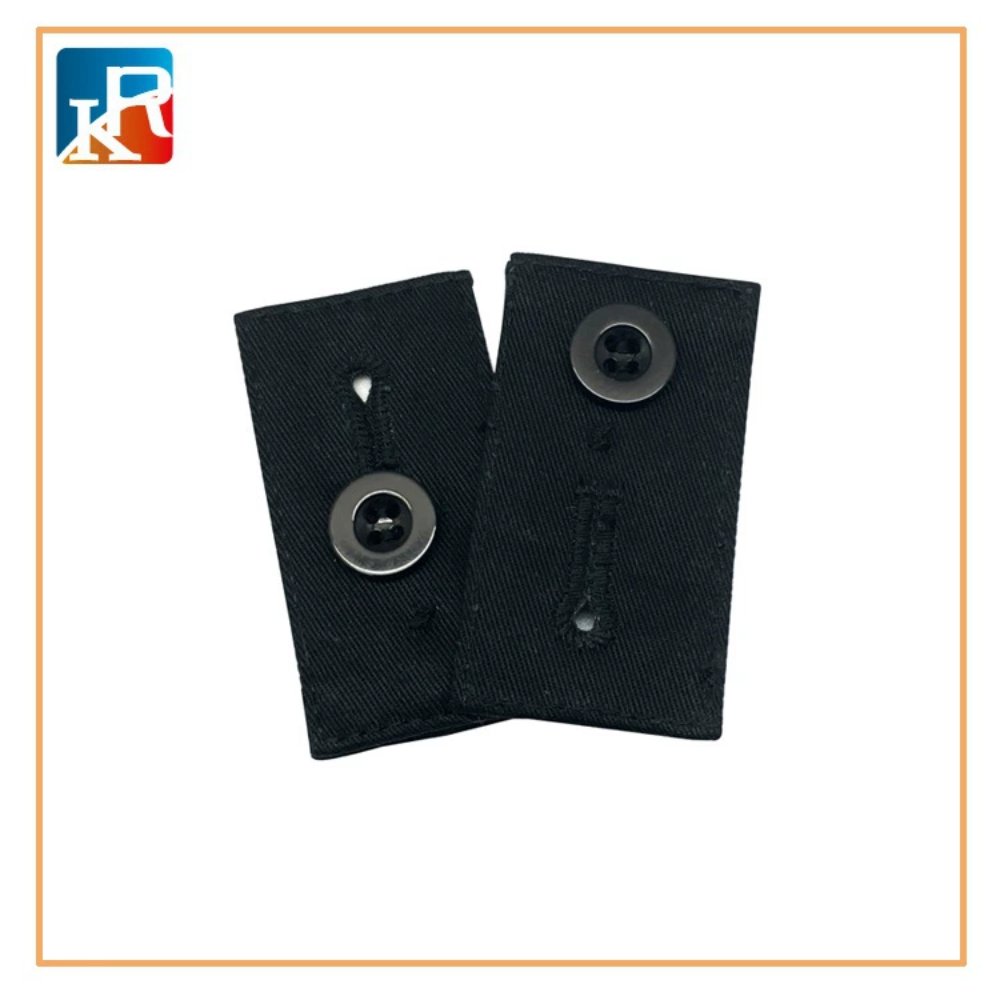
Official front reference for a component declaration request. Black appearance does not identify fibre or button composition.
Start with the actual tab and the missing declaration
Kangrui’s saved Jeans Adjustable Button listing identifies the product and gives named colour options. The reviewed page does not provide a component-level material declaration. The official photos show textile-looking tabs, buttons and elongated openings, which identify the enquiry but cannot serve as a material analysis.
For wholesale garment accessories, request the offered product reference before discussing composition. A buyer needs to know which sample and construction the supplier is describing. Similar-looking tabs can be quoted under different references, so a general category description should not replace a specific declaration.
This request is separate from approving colour appearance or checking the interface with a garment. It asks what the supplier says the components are made from and what information supports that statement. Neither a colour sample nor a dimensional drawing automatically answers those material questions.
Buying field
Requested supplier response
Textile tab
Supplier material or composition statement for the offered tab and its stated coverage.
Attached button
Supplier description of the button material and any separately declared finish.
Stitching
Relevant thread or fastening-material information for the offered construction.
Surface treatment
Supplier-identified treatment or coating where applicable, including its component scope.
Supporting reference
Document identifier, issue or other available basis linked to the actual offered product.
Variant coverage
Which quoted colours and versions share the declaration and which require a separate response.
Keep each component statement identifiable
Ask the supplier to describe the tab and button as separate lines. A statement about the textile portion should not silently become a statement about the attached hardware. If the supplier uses a trade description, request the clarification needed to understand its intended scope instead of replacing it with a guessed technical term.
Where a composition figure or named material is provided, retain the exact supplier wording and the component it covers. If the supplier does not have a complete declaration, record which field remains unavailable. Do not fill that gap by identifying a fibre from a woven appearance or a metal from its colour.
Ask whether stitching or another fastening detail is included in the material response when it matters to the order. This does not require pretending that every visible component has already been documented. It gives the supplier a practical way to return a complete and clearly divided answer.
Official catalogue construction reference. Ask the supplier to identify the materials and any applicable finishes.
Separate base material from a surface finish
A button’s surface appearance does not establish its base material or treatment. Ask the supplier whether it is describing the underlying component, an applied finish or the finished button as supplied. Keep those descriptions distinct if the response contains information for more than one layer or component.
If the supplier proposes a coating or other treatment, ask for the available description and the product reference it covers. Do not turn an appearance term into a claim about corrosion resistance, skin contact, durability or another performance characteristic. Those are separate questions requiring their own appropriate support.
The same discipline applies to the textile tab. A visible colour or texture is useful for identifying a sample, but it does not establish its fibre content, stretch performance or care requirements. Request the supplier’s relevant information rather than using a photograph to supply an undocumented specification.
Check the document scope before reusing a statement
When the supplier provides a document, ask which offered reference it covers and how the sample is linked to it. Identify whether the information concerns a raw material, an individual component or the finished accessory. A document for one scope should not be described as proof for a broader scope without confirmation.
Retain the document identifier and version alongside the supplier declaration. If supporting information is unavailable, keep that limitation explicit in the purchasing record. A clear unanswered field is more useful than a confident material claim copied from another product or inferred from a catalogue label.
This guide does not certify a composition, select a market-specific requirement or report that a test has passed. The buyer’s practical task is to obtain traceable supplier information for the intended order and identify any additional review needed for the proposed product description.
Official colour-reference row. Request the material-declaration coverage for each offered variant; colour alone does not prove a shared composition.
Confirm coverage across the quoted variants
The listing names several colours, but that does not establish that every variant has the same material or finish. Ask the supplier to state which offered variants share its declaration. If a variation changes a component or treatment, request a response that identifies the difference.
Keep colour approval and material approval as separate decisions. A buyer may accept the appearance of a sample while still waiting for a component declaration. The quotation should show that status clearly so an approved photograph is not mistaken for approval of a composition or finish claim.
Before reordering, identify any product-reference or construction change that could affect the declaration. Request a supplier confirmation for the proposed version instead of silently carrying older wording into a new order. Preserve the previous response as history while marking the information that now applies.
Buyer FAQ
Can the tab fibre be identified from the photograph?
No. Request the supplier declaration for the actual textile portion and its offered version.
Does a shiny button prove a particular metal?
No. Ask separately about base material and any surface finish; appearance does not establish either.
Does colour approval also approve the material?
No. They are separate review decisions and should remain identifiable in the quotation record.
Can a raw-material document prove the finished tab specification?
Confirm its scope and linkage first. Do not automatically extend component information to the complete accessory.
What if one declaration field is missing?
Keep it open and request the supplier’s available information. Do not invent a fibre, alloy, coating or test result.
Use the actual Jeans Adjustable Button catalogue reference and request the supplier information for your offered version. The Kangrui purchasing blog covers related sample and quotation questions.
Request separate component declarations.
Identify document and variant coverage.
Keep material approval separate from appearance approval.
wholesale garment accessoriesB2B supplier sample record